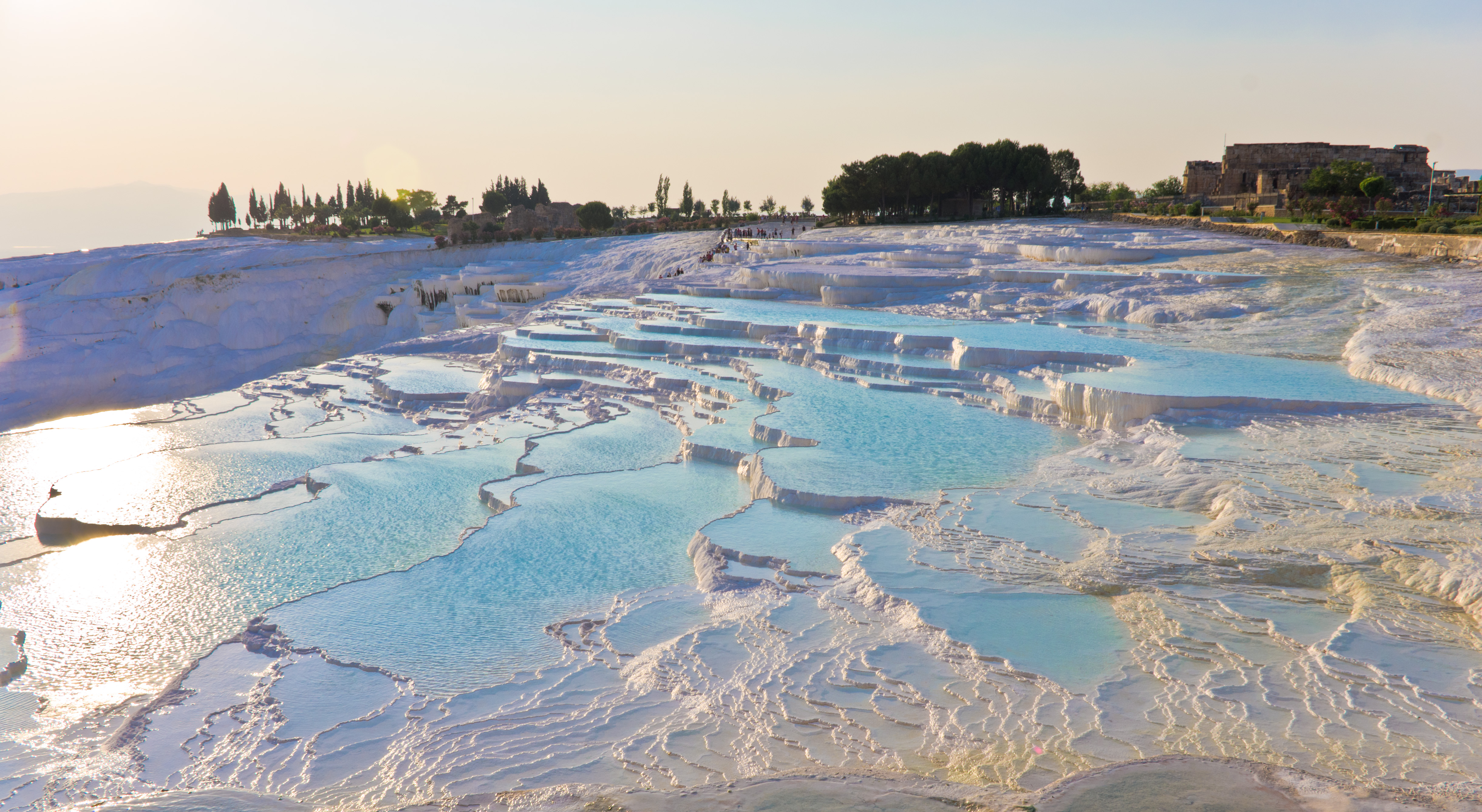
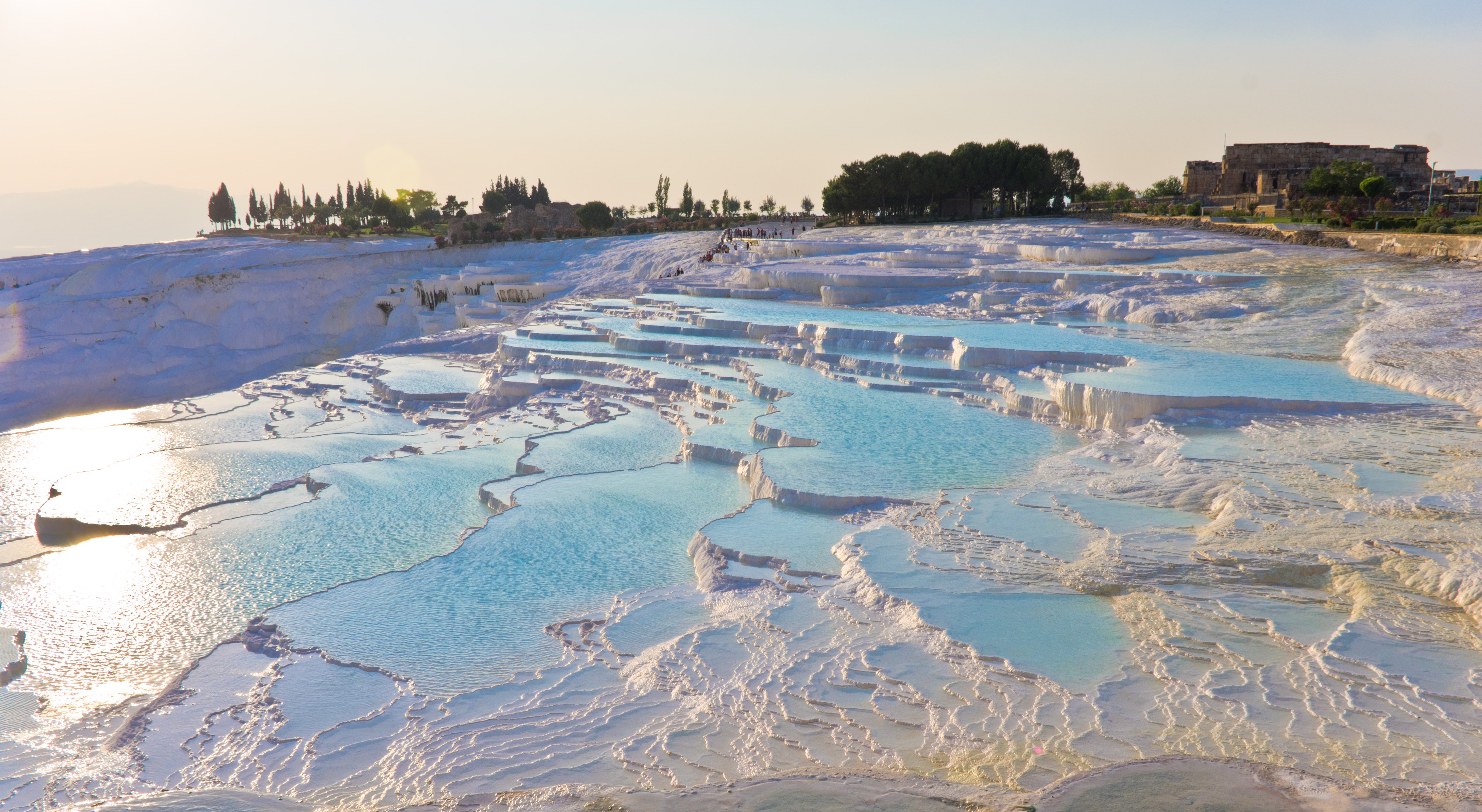
Immerse yourself in the magical whiteness of Pamukkale, a natural wonder of thermal waters and limestone terraces.
The Pamukkale Travertines usually open from 8:00 AM until sunset, but I recommend checking the latest hours on the official website, as they may vary by season. The main entrance is at the top, near Hierapolis, although you can also enter from the lower entrance. You can find more details on the information page at Go Türkiye.
Admission to Pamukkale and Hierapolis is managed as a single archaeological and tourist site, so it is not free. The current price is around 400 TL (Turkish lira) for adults, although I recommend checking the exact cost at the ticket office or on the official website of Turkey’s Ministry of Culture and Tourism, as prices may change. Keep in mind that combined passes with other attractions in the area are also often available.
To fully enjoy the Pamukkale Travertines and the ancient city of Hierapolis, I recommend allowing at least half a day, around 3 to 4 hours. This will give you time to walk across the white terraces, take a dip in some of the pools, explore the ruins of Hierapolis, and visit the Archaeological Museum if that interests you.
The Pamukkale Travertines, whose name means 'Cotton Castle' in Turkish, are the result of thousands of years of calcium carbonate deposits from the thermal waters. Their cultural significance is closely tied to the ancient city of Hierapolis, which was an important center of healing and pilgrimage in antiquity because of the curative properties of these waters. Both sites are protected as a UNESCO World Heritage Site.
The best time to visit the Pamukkale Travertines is during spring (April-May) or autumn (September-October), when temperatures are more pleasant and there are fewer tourists. To avoid the daily crowds, I suggest going early in the morning right when the site opens, or late in the afternoon before closing, so you can also enjoy the sunset over the terraces.
Accessibility at the Pamukkale Travertines can be challenging for people with reduced mobility. The travertine terraces are uneven and slippery, so they are not suitable for wheelchairs. However, some areas of Hierapolis and the surrounding grounds are better adapted. I recommend contacting the site administration directly for specific information about accessibility at the upper entrance or paved areas.
Absolutely—very close to the travertines you’ll find the fascinating ancient city of Hierapolis, with its impressive Roman theater, Cleopatra’s Pool, and the Domitian Gate. If you feel like exploring a bit farther, a short drive away you can visit the ancient city of Laodicea, another Roman archaeological site with well-preserved ruins. There are also several thermal springs and spas in nearby towns such as Karahayıt.
Of course! First, bring sunscreen and a hat, as there is very little shade. To walk on the travertines, you’ll be asked to remove your shoes, so keep that in mind and bring a bag to carry them. Don’t forget your swimsuit if you want to dip into the warm-water pools. If you’re visiting with children, Cleopatra’s Pool is a fun experience where they can swim among fallen Roman columns. And don’t forget your camera for the incredible photos!
¿Prefieres escuchar en español?
🇪🇸 Escucha la audioguía de the Pamukkale Travertines en español