
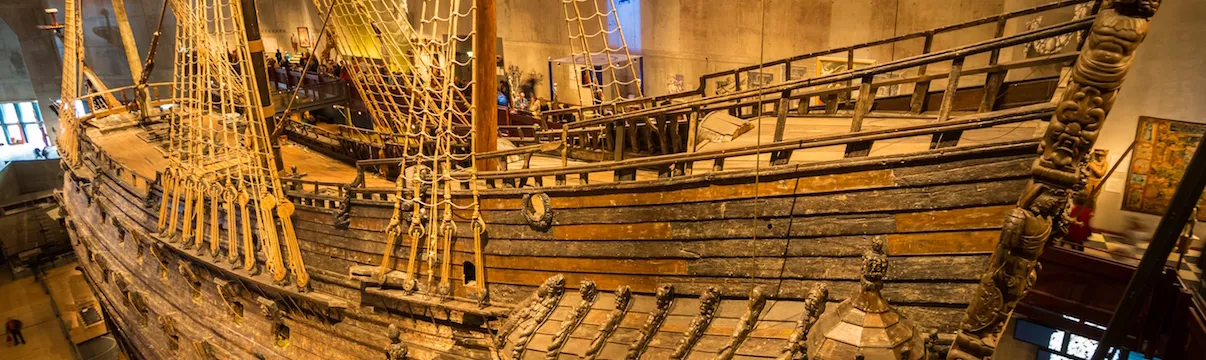


The royal galleon that sank on its maiden voyage before thousands of eyes... and returned from the seabed to tell the whole story.
The Vasa Museum usually opens from 10:00 AM to 5:00 PM, although in summer the hours may be longer (until 6:00 PM). I always recommend checking the latest schedule on the official website before your visit. It is located on Djurgården Island, and you can get there easily by tram, bus, ferry, or even on foot from central Stockholm. For more details on how to get there and opening hours, visit the museum's 'Plan your visit' section: Opening hours and how to get to the Vasa Museum.
Adult admission to the Vasa Museum costs around 170 SEK. Children and young people up to 18 years old enter free of charge. There are also discounts for students with an international student card. It is best to buy tickets online in advance to avoid lines and secure entry, especially in peak season. You can check updated prices and buy tickets directly on the museum website: Vasa Museum Tickets and Prices.
To have a good experience and appreciate everything the Vasa Museum offers, I recommend setting aside at least 1.5 to 2 hours. If you like reading the exhibits in detail and watching the documentaries, you could extend your visit to 3 hours. Remember that the audio guide is essential for understanding the ship's context and history, so I encourage you to consider using one to make the most of your time.
The Vasa ship is crucial because it is the world's only nearly intact preserved 17th-century ship. Its story is a fascinating time capsule that transports us to 17th-century Sweden and shows us the naval power of the era, its ambitions, and, ironically, its miscalculations as well. Its recovery and preservation are a testament to advanced maritime archaeology and a symbol of Swedish cultural heritage.
To avoid the biggest crowds, I suggest visiting the Vasa Museum during the low season (autumn or winter, excluding holidays) or, if you travel in summer, try to go first thing in the morning right when it opens or late in the afternoon before closing. Weekdays are usually less crowded than weekends. Avoid midday in peak season if you do not like crowds.
Yes, the Vasa Museum is designed to be fully accessible. All exhibition areas are wheelchair accessible, and there are elevators and ramps available to move between the different levels. They also have accessible restrooms. You can find more detailed information about accessibility on their website: Accessibility Information at the Vasa Museum.
The Vasa Museum is located on Djurgården Island, which is full of other fantastic attractions. Very nearby, you can visit Skansen, the ABBA Museum, or Junibacken, a children's museum inspired by Astrid Lindgren. You can also enjoy a pleasant walk around the island or take a coffee break at one of the nearby cafés. Djurgården is a green and cultural oasis in Stockholm.
Of course! First, buy your tickets online in advance to save time. I strongly recommend downloading an audio guide before your visit; it will help you understand the ship's fascinating history and details without missing anything. Dress in layers, as the temperature inside the museum is kept constant to preserve the ship, which can feel cool. And do not forget to take plenty of photos, but without flash so as not to damage the exhibits!
¿Prefieres escuchar en español?
🇪🇸 Escucha la audioguía de Vasa Museum en español