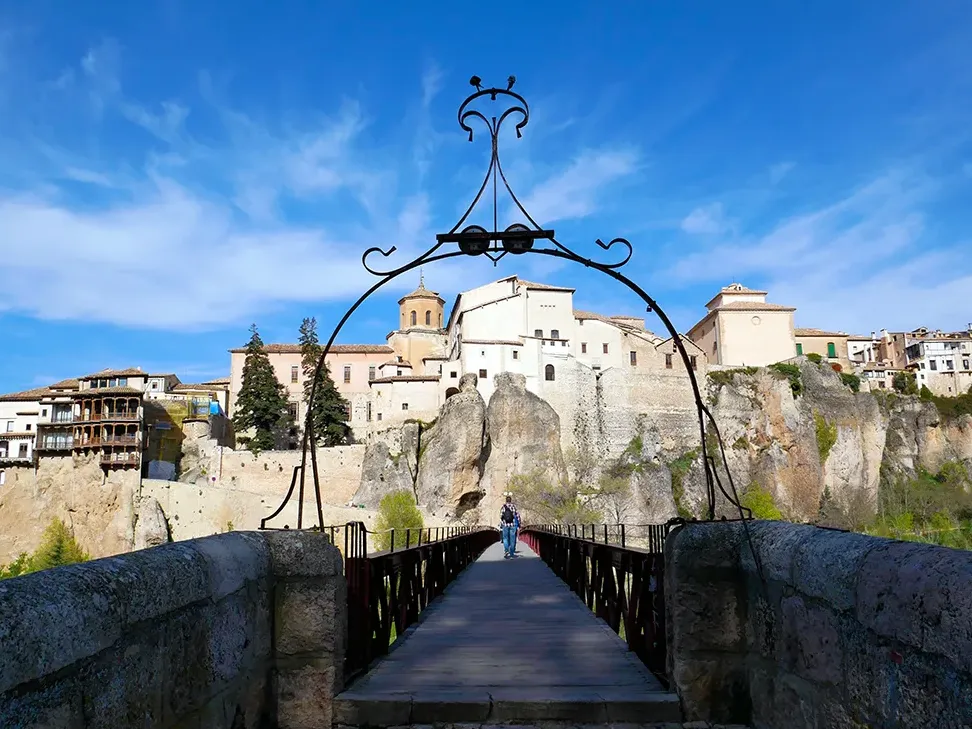
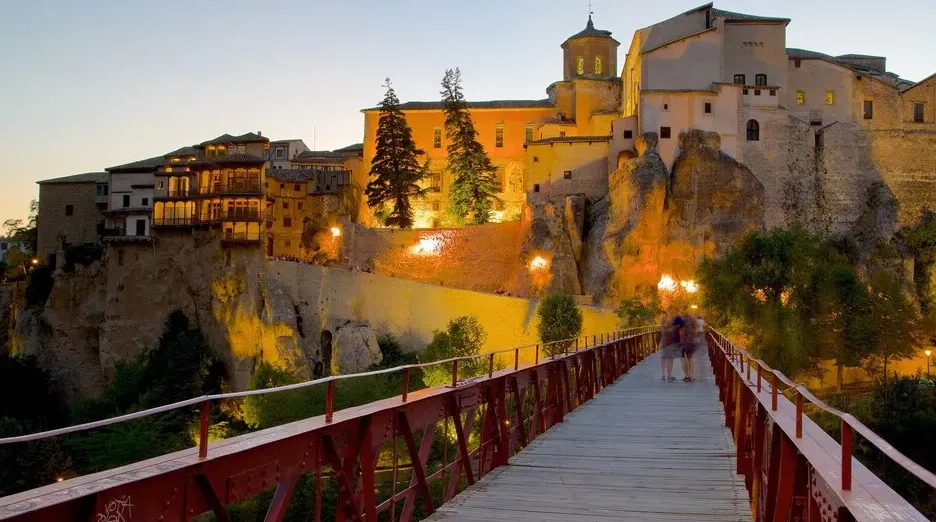
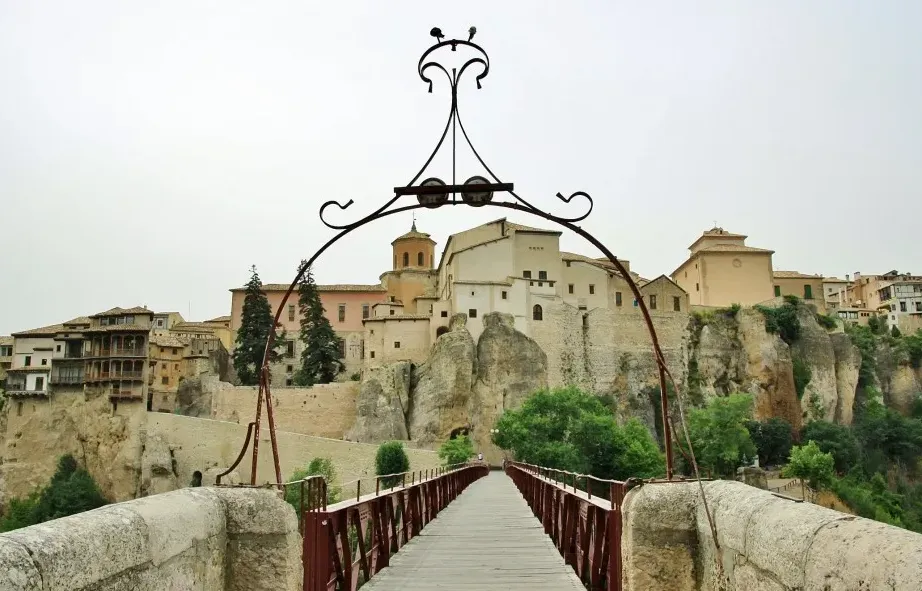
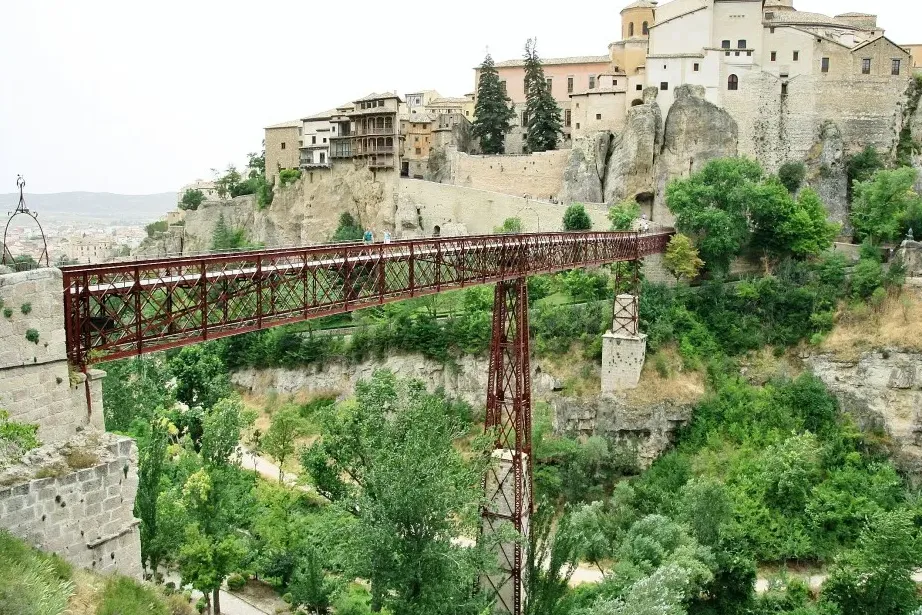
El Puente San Pablo es un emblemático puente colgante sobre el río Júcar en Cuenca, que conecta el casco histórico con el Barrio del Castillo y ofrece vistas únicas de las Casas Colgadas.
St. Paul Bridge is a pedestrian walkway and is open 24 hours a day, 7 days a week, as it is a public thoroughfare. To get there, we recommend parking in the lower part of the city and walking up, or parking in lots near the upper area, such as the one by the Castle. It is a very pleasant walk that connects Cuenca's old town with the Parador. You can find more information on the Cuenca Tourism website.
Not at all! St. Paul Bridge is a completely public and free attraction. You can cross it, enjoy the views, and take as many photos as you like at no cost. It is one of the great gifts Cuenca offers its visitors, with no tickets or fees required.
Crossing the bridge itself will take only about 5 to 10 minutes. However, we recommend allowing at least 30 to 45 minutes for your visit. You will want to stop, admire the stunning views of the Hanging Houses and the Huécar Gorge, and take plenty of photographs. It is a place to soak in the beauty of the surroundings.
The current St. Paul Bridge was built in the early 20th century (opened in 1903) in iron and wood, replacing an earlier 16th-century stone bridge that had collapsed. Its importance lies in the fact that it connects the Convent of St. Paul, now the National Parador, with Cuenca's old town and offers the most iconic views of the famous Hanging Houses. It is a symbol of the city and a remarkable work of engineering for its time.
For spectacular photographs and to avoid crowds, we suggest going early in the morning or at sunset. The light at those times is magical and enhances the beauty of the landscape. As for the best time of year, spring and autumn, with mild temperatures and colorful scenery, are ideal. In summer it can be very hot at midday.
St. Paul Bridge is a pedestrian walkway with wooden planks over a metal structure. Although it has no steps, the surface may be slightly uneven, and the slope for access from both sides may require assistance for wheelchairs or for people with very limited mobility. The best way to assess it is to approach carefully. Access to the bridge is via a ramp or a flat path from the Parador or the old town.
Of course! Right next to the bridge are the famous Hanging Houses, which house the Museum of Spanish Abstract Art. You can also visit Cuenca Cathedral in the Plaza Mayor, Plaza de la Merced, or the Cuenca Museum. The Parador of Cuenca, formerly the Convent of St. Paul, is also worth a look. The entire old town is a World Heritage Site, so there is plenty to explore just a few steps away.
We recommend wearing comfortable shoes, as Cuenca is a city with many steep streets. Do not forget your camera; the views are unforgettable. If you are visiting in high season, try to go early or late in the afternoon to avoid crowds. Also, do not stop at the bridge alone—take the opportunity to explore the streets of the old town and enjoy the local cuisine. And of course, consider an audio guide from IAudioguia to fully discover its history as you walk.
¿Prefieres escuchar en español?
🇪🇸 Escucha la audioguía de St. Paul Bridge en español