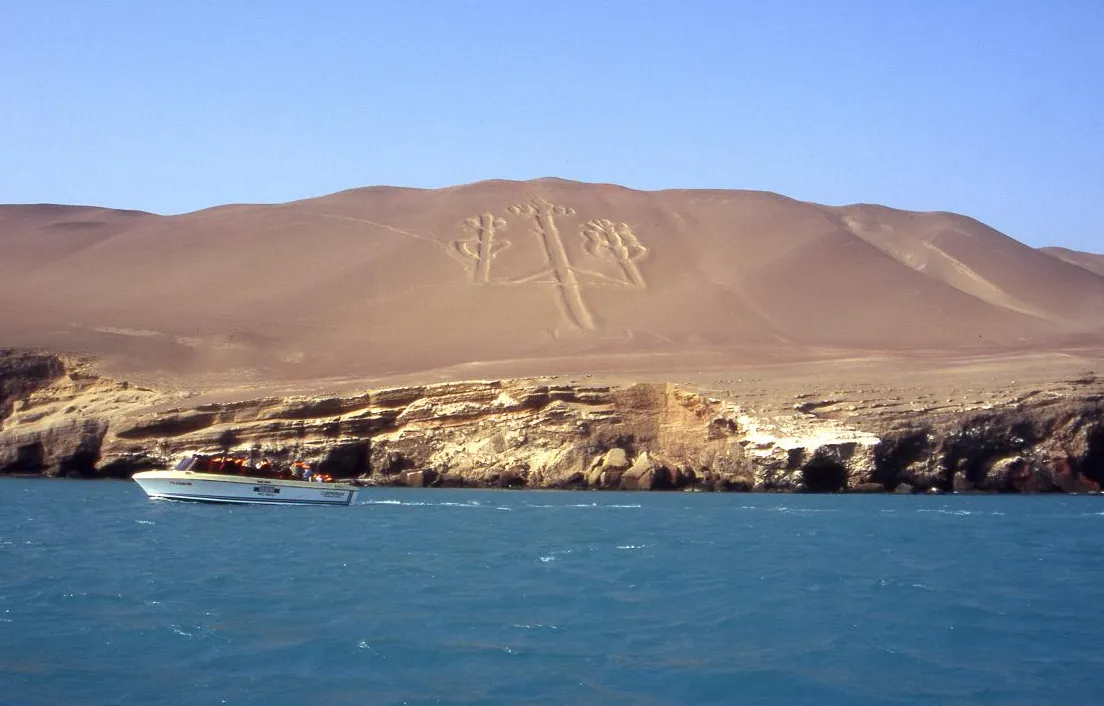
An enigmatic pre-Hispanic geoglyph that marks the coastal landscape of Pisco, defying time and interpretation.
The Paracas Candelabra, located on the Paracas Peninsula, is visible from the sea, as it forms part of the coastal desert. It does not have specific visiting hours like a museum. The best way to see it up close is on a boat excursion to the Ballestas Islands. These usually depart from the port of El Chaco in Paracas, with various schedules starting early in the morning. You can find tour operators at the port or book online in advance. One popular option is this Ballestas Islands tour.
Seeing the Paracas Candelabra itself is free, since it is part of the landscape. However, to view it up close, you will need to pay for a boat excursion to the Ballestas Islands, which includes seeing the geoglyph. Prices vary by operator, but they generally cost around 20 to 30 Peruvian soles, plus a reserve entrance fee of about 10 to 11 soles. We recommend checking with the operator before boarding. For example, you can view some packages here.
Viewing the Paracas Candelabra is part of the Ballestas Islands excursion, which usually lasts a total of about 2 to 2.5 hours. The boat stops in front of the geoglyph for around 10 to 15 minutes to allow for viewing and photos before continuing to the islands. Therefore, the time dedicated specifically to the Paracas Candelabra is relatively short, but enough to appreciate it. If you include travel from your hotel to the port and back, plan on about 3 to 4 hours for the full activity.
The Paracas Candelabra is an enigmatic prehistoric geoglyph of great size, about 180 meters long, whose exact age and purpose are still debated. Although its origin is uncertain, it has been linked to the Paracas or Nazca culture, or perhaps to an earlier or unified civilization of Peru’s southern coast. Interpretations vary widely, from a marker for ancient sailors to a representation of the Southern Cross constellation or a symbol of Pachamama. Despite these theories, its true purpose remains a mystery, which makes it even more fascinating. You can read more about the theories at this Wikipedia link.
The best time of day to see the Paracas Candelabra is in the early morning, when most Ballestas Islands excursions depart. At that time, the light is usually softer, there is less wind, and visibility is optimal. As for the best time of year, Paracas has a desert climate with sunshine almost all year round. However, avoiding the summer months from December to March may be preferable if you want fewer crowds, although tours are available year-round.
Because the only way to see the Paracas Candelabra is from a boat at sea, accessibility depends on how easy it is to board and disembark at the port of El Chaco and on the boat itself. Some boats may not be fully adapted for wheelchairs, although the staff are usually very helpful. It is recommended to contact the tour operator directly in advance to ask about their specific accessibility facilities and whether they can provide extra assistance. It is advisable to look for operators that offer the flattest possible boarding access. Unfortunately, there is no specific official accessibility link covering all operators, but you can look for tours offered by operators that provide this feature.
After visiting the Paracas Candelabra and the Ballestas Islands, I recommend exploring the Paracas National Reserve, a stunning desert landscape with unspoiled beaches and rock formations such as La Catedral, although only its base remains after an earthquake. You can also visit the reserve’s Interpretation Center to learn about its biodiversity and history. In addition, the town of Paracas offers a relaxed atmosphere, restaurants serving fresh seafood, and lodging options. Consider booking a tour that combines the Ballestas Islands and Paracas National Reserve to make the most of your day.
Of course—here are a few tips. First, book your Ballestas Islands tour in advance, especially in high season. Second, bring sunscreen, a hat, and sunglasses, as you will be exposed to the sun on the boat. Third, a windbreaker or light jacket can be useful, especially early in the morning at sea. Fourth, bring a camera with a good zoom to capture detailed photos of the Paracas Candelabra and the wildlife. Finally, enjoy the mystery and natural beauty of the place. Do not forget to bring some cash for the reserve entrance fee and any small purchases. More useful information.
¿Prefieres escuchar en español?
🇪🇸 Escucha la audioguía de the Paracas Candelabra en español