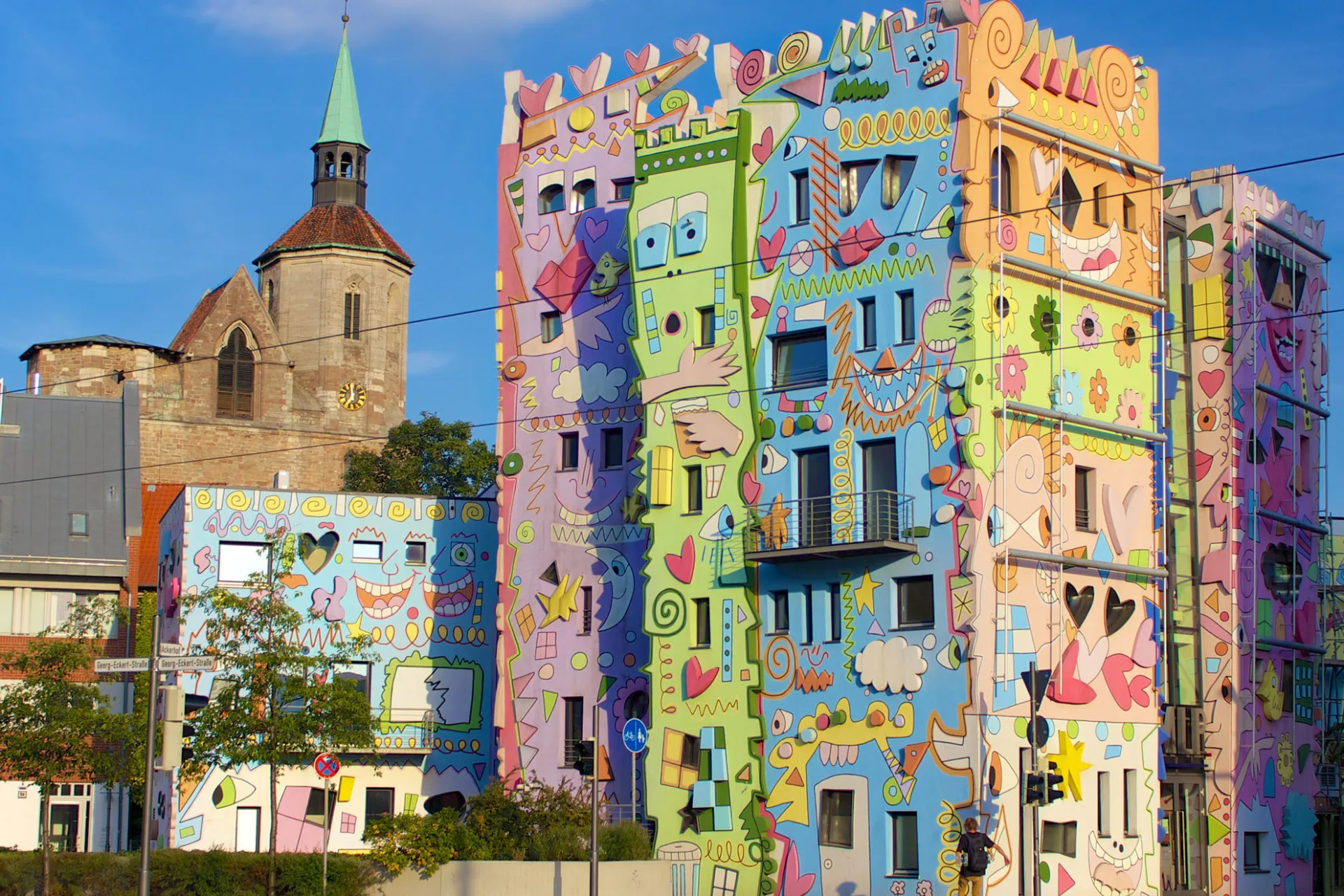
El edificio que le puso color a la historia gris del barrio mas polémico de Braunschweig
Unfortunately, the interior is not open to the general public, as it houses the offices of the fashion company New Yorker, so there are no guided tours inside. However, the truly spectacular part is its exterior façade in Ackerhof, accessible 24 hours a day so you can enjoy its art at any time.
No, the visit is completely free because it is an architectural attraction in a public space. You can walk up to the square, circle the building, and admire James Rizzi’s art without needing to book or buy tickets.
The visit is usually brief; we recommend allowing 20 to 30 minutes, which is enough time to walk around the complex and observe the details. It is a perfect quick photo stop while exploring the charming Magniviertel district.
Opened in 2001, this work is the result of a collaboration between pop artist James Rizzi and architect Konrad Kloster, creating a bridge between art and Braunschweig’s urban architecture. Its importance lies in how it breaks conventions by integrating graffiti and cartoon-like forms into a historic setting, symbolizing pure happiness and optimism.
Without a doubt, try to go on a sunny day, preferably in the morning or during the golden hour at sunset, so the natural light intensifies the neon colors. Although the building brightens any gray day, the contrast with a clear blue sky will guarantee your best photos for social media.
Yes, the main view from Ackerhof Square is accessible, as it is a flat, paved public space. However, keep in mind that the surrounding streets in the historic Magniviertel district still preserve old cobblestones, which may require a bit more effort to navigate.
You are in the historic heart of the city, so right across from it you will find the historic St. Magni Church and a wide variety of medieval half-timbered houses. In addition, just a few minutes away on foot you can visit Dankwarderode Castle and the Herzog Anton Ulrich Museum.
Look closely at the windows, as each one has a different shape and expression, and do not stop at just the front; walk around to see how the modern building interacts with the adjacent historic ruins. If you want to go deeper, we suggest bringing a downloaded audio guide to understand the artistic context while you look at it.
¿Prefieres escuchar en español?
🇪🇸 Escucha la audioguía de Happy Rizzi House en español